
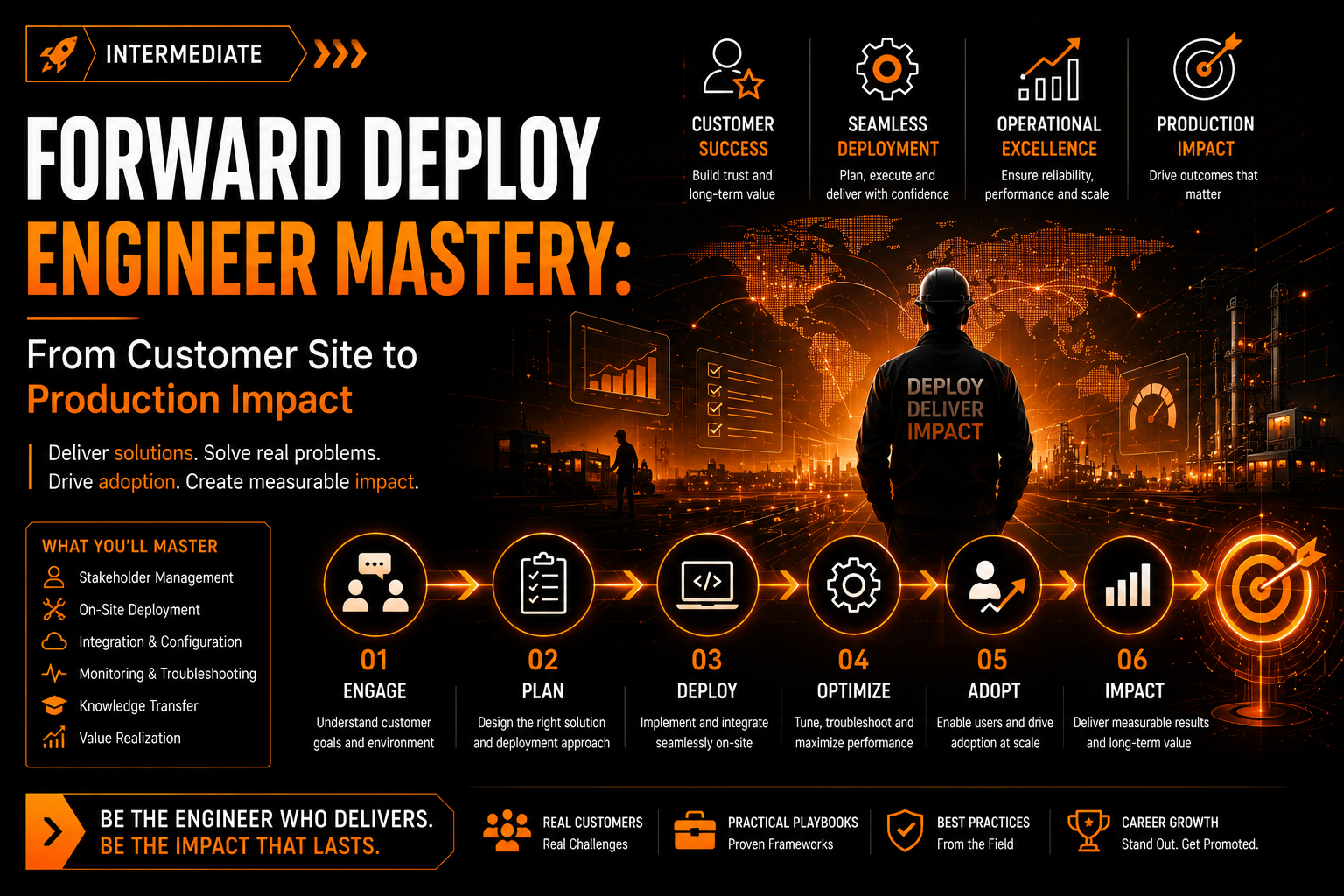
Forward Deploy Engineer Mastery: From Customer Site to Production Impact
A complete career-grade course for aspiring Forward Deploy Engineers (FDE). Learn the embedded-engineer model, discovery and domain capture, on-site data plumbing, operational app building, deployment, and the soft skills that separate good FDEs from great ones.
Course Content
Forward Deploy Engineer Mastery
A Forward Deploy Engineer (FDE) is a particular kind of software engineer: one who is dropped into the customer’s office, learns their workflow on Monday, sketches a model on Tuesday, ships code on Wednesday, and is back on Thursday asking the operator why a button is in the wrong place.
The role was popularized by Palantir, and it has since spread — under different names — to most serious enterprise platform companies (Anduril, Scale, OpenAI’s Solutions team, Anthropic’s Applied AI team, the new generation of vertical AI startups). The titles vary. The job is the same: be the human bridge between a powerful platform and a customer who does not yet know how to use it to solve their problem.
This course is for software engineers who want to do that job.
What you will learn to do
By the end of this course you will be able to walk into a customer site cold, leave 6–12 weeks later with a deployed system that the customer actively uses, and have the documentation, ontology, and team trained to keep it running after you leave.
That is the whole job. Everything below is in service of it.
What you will build
The course is built around a running scenario: you are the lead FDE for Northbound Freight, a mid-size logistics company drowning in spreadsheets, with three legacy systems that don’t talk to each other and a CEO who wants on-time delivery to go from 78% to 92% in a quarter.
Across the course you will:
- Run a discovery process — interview a fictional dispatcher, an ops VP, and a skeptical IT director
- Capture the domain as an ontology of shipments, hubs, vehicles, drivers, customers, and routes
- Plumb the data — a Postgres export, a daily SFTP drop, a SOAP endpoint, and a CSV someone emails every morning
- Build the dispatcher’s app — a real operational workflow that replaces three browser tabs and a notebook
- Layer in an agentic assistant that reads the ontology and suggests reroutes
- Deploy to production at Northbound, dual-run for two weeks, and cut over
- Hand off to the customer’s internal team, with a runbook they can actually use
Each phase of the course advances the same scenario, so by the end you have a portfolio-grade case study you can talk through in an FDE interview.
Course structure
The course is organized in six phases plus a capstone:
Phase 1 — The FDE Mindset (Lessons 1–3)
Who FDEs are, why the role exists, and the weekly deployment loop that defines the work.
Phase 2 — Discovery and Domain Capture (Lessons 4–6)
The interview craft, the modeling craft, and the scoping craft — the three crafts an FDE practices on day one of every engagement.
Phase 3 — Technical Foundations (Lessons 7–10)
Plumbing data out of legacy systems, designing the semantic layer, integrating with enterprise APIs, and operating securely inside customer infrastructure.
Phase 4 — Building Operational Apps (Lessons 11–14)
From the ontology, build the apps. Low-code, pro-code, AI agents, and dashboards — and when to use each.
Phase 5 — Deploy, Iterate, Hand-off (Lessons 15–17)
The actual cutover. Change management. The hand-off that determines whether the project survives.
Phase 6 — The Soft Skills (Lessons 18–19)
Executive communication and procurement/security/legal — the off-keyboard work that decides whether you ever get to write code.
Capstone — A 6-Week Simulated Engagement
A full end-to-end FDE deployment for Northbound Freight. You will produce the artifacts a real FDE produces: a problem statement, a domain model, an MVP plan, a working application, a deployment plan, and a hand-off package.
Who this course is for
- Software engineers who want to move closer to customers, problems, and impact — and further from ticket queues
- Solutions engineers and sales engineers who want to build, not just demo
- Consultants who want the technical depth to ship the systems they recommend
- New grads targeting the FDE role at Palantir, Anduril, Anthropic, OpenAI, Scale, or any of the new vertical AI companies
- Engineering managers who hire FDEs and want to understand the work well enough to hire and coach for it
Who this course is not for
If you want to stay at your desk, own a single service, and have a product manager hand you a spec — this is not your course. FDE work is messy, customer-facing, and requires writing prose and code on the same day. That is the appeal, but it is not for everyone.
How to take this course
The lessons build on each other. Phase 1 and 2 establish the mindset and method; Phase 3 and 4 are where the keyboard work happens; Phase 5 and 6 are where most engineers under-invest and most FDEs differentiate themselves. Take them in order.
The capstone is a multi-week project. Block out time for it — it is the artifact you will take to interviews and to your first engagement.
Let’s begin with the most important lesson: what an FDE actually is, and what they actually do.
📋 Prerequisites
- 2+ years of professional software engineering experience
- Comfort with at least one typed language (TypeScript, Java, Python with typing, or Go)
- Familiarity with REST APIs, SQL, and basic data modeling
- Willingness to talk to non-engineers and translate their problems into systems
🎯 What You'll Learn
- Explain the FDE role and where it fits in modern enterprise software delivery
- Run discovery interviews with non-technical stakeholders and extract a workable problem statement
- Capture a customer domain as a typed object/link/action model
- Scope and ship a value-delivering MVP inside a single sprint
- Integrate against legacy enterprise systems (SAP, Oracle, mainframe exports, broken CSVs)
- Build operational applications that operators actually adopt
- Deploy AI and agentic workflows responsibly on top of customer data
- Deploy to production at a customer site — including rollback, dual-running, and adoption
- Communicate progress and risk to executives in writing and in person
- Run a complete 6-week FDE engagement end to end