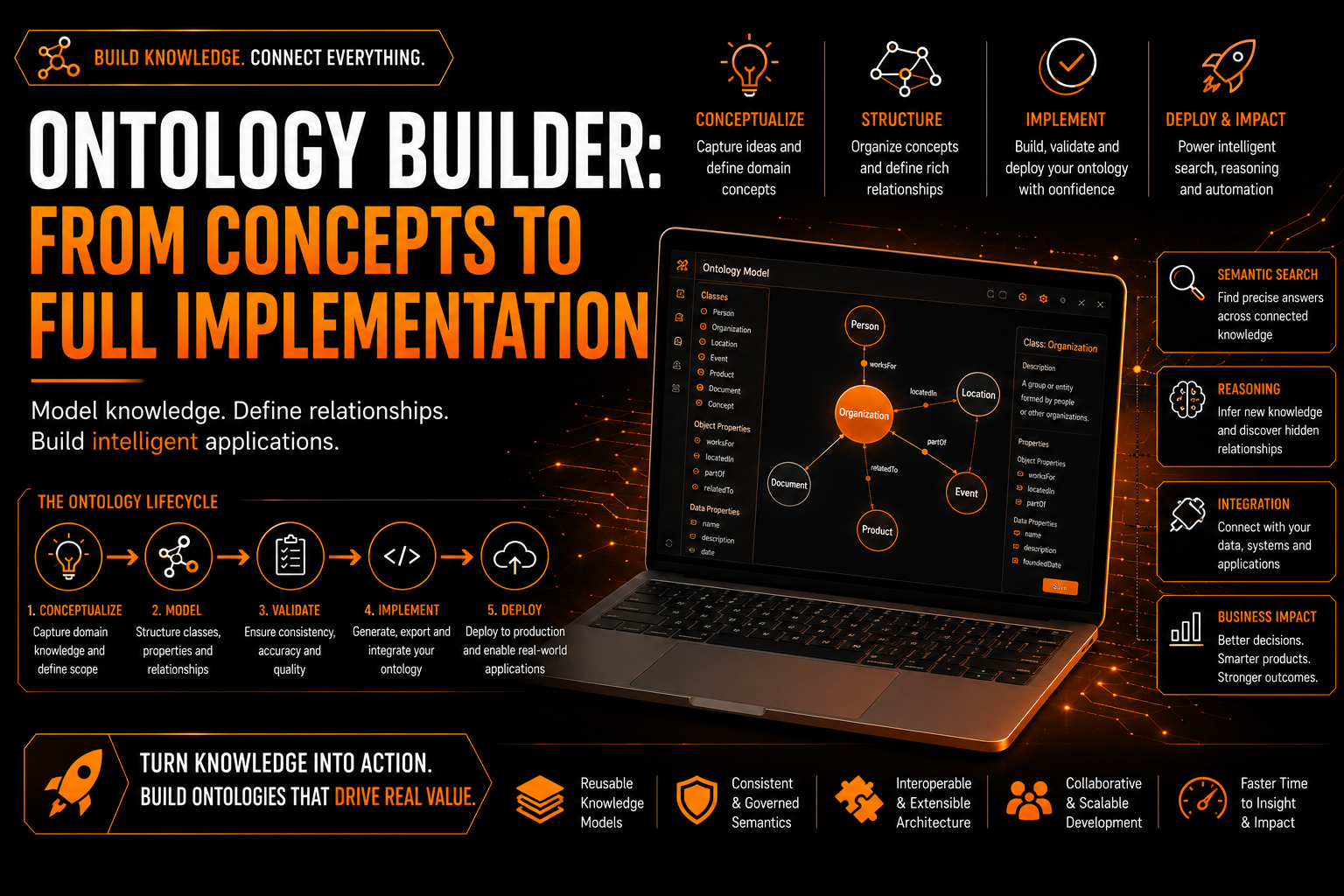
Ontology Builder: From Concepts to Full Implementation
Master the ontology — the semantic layer that turns raw data into a connected, operational model of your business. Learn object types, link types, actions, functions, and how to build a complete production-ready ontology.
Course Content
Ontology Builder: From Concepts to Full Implementation
The ontology is the semantic layer between your raw data and the applications, dashboards, and decisions your organization depends on. Instead of every team re-deriving “what is a customer?” or “what counts as a shipment in transit?” from scratch, the ontology defines those concepts once, with types, relationships, behaviors, and governance — and every downstream consumer reads from the same model.
This course takes you from the conceptual foundations all the way to a production-ready ontology you build with your own hands.
What you will build
- A domain model for a real business (we use a logistics company as the running example): customers, orders, shipments, hubs, vehicles, drivers, telemetry.
- Object types for each entity, with proper property typing, validation, and primary keys.
- Link types wiring entities into a graph — orders to customers, shipments to vehicles, drivers to hubs.
- Action types that mutate the ontology safely:
assignDriverToShipment,markDelivered,rerouteShipment— each with typed parameters, validations, and audit trails. - Functions that compute derived state: estimated time of arrival, current capacity utilization, on-time delivery rate.
- A security model with object-, property-, and row-level controls.
- A migration plan to evolve the ontology safely as the business changes.
Course structure
The course is organized in four phases:
Phase 1 — Concepts (Lessons 1–3)
The “why” behind ontologies, the semantic layer pattern, and the architecture that makes it all work.
Phase 2 — The Building Blocks (Lessons 4–10)
Each of the core primitives in depth: object types, properties, link types, actions, functions, object sets, datasources.
Phase 3 — Hands-On Implementation (Lessons 11–14)
From an empty workspace to a working multi-entity ontology with mutating actions and live functions.
Phase 4 — Production-Grade (Lessons 15–19)
Security, versioning, best practices, and a capstone that pulls everything together.
Prerequisites
You should be comfortable modeling data in a relational schema, reading typed code in TypeScript / Java / Python, and reasoning about REST APIs. No prior ontology or knowledge-graph experience is required.
Who this course is for
- Data engineers who want to move beyond ETL into modeling the business itself.
- Platform engineers building developer platforms on top of organizational data.
- Solution architects integrating multiple source systems behind a single coherent model.
- Backend engineers who write services that read and write business state.
- Analysts and data scientists who want their work to compose with the rest of the organization, not live in isolated notebooks.
How to take this course
Lessons build on each other — Phase 1 and 2 establish vocabulary you will need throughout Phase 3 and 4. Each lesson takes 45–120 minutes. The capstone is a multi-session project.
By the end, you will have shipped a complete operational ontology and will be able to design, evolve, and govern one in any tooling that supports the pattern.
Let’s begin.
📋 Prerequisites
- Comfort with relational data modeling (tables, joins, primary/foreign keys)
- Basic familiarity with a typed language (TypeScript, Java, or Python)
- Understanding of REST APIs and JSON
🎯 What You'll Learn
- Explain what an ontology is and why it sits between raw data and applications
- Model a business domain as object types, link types, and action types
- Implement typed actions that safely mutate ontology state
- Write functions that compute derived values and power applications
- Integrate datasources (datasets, streams, APIs) into the ontology
- Apply object-, property-, and row-level security with markings
- Evolve an ontology in production using branching, versioning, and migrations
- Ship a complete operational ontology end-to-end